

This past Election Day was a day of celebration for the Democratic Party all over the country. The numerous victories of democratic candidates signify a shift in the political climate, likely in response to the current administration of the federal government. Among their biggest wins were the New Jersey and Virginia governor-elects and the Prop 50 vote in California. Particularly noteworthy was the election of progressive liberal Zohran Mamdani as mayor of New York City.
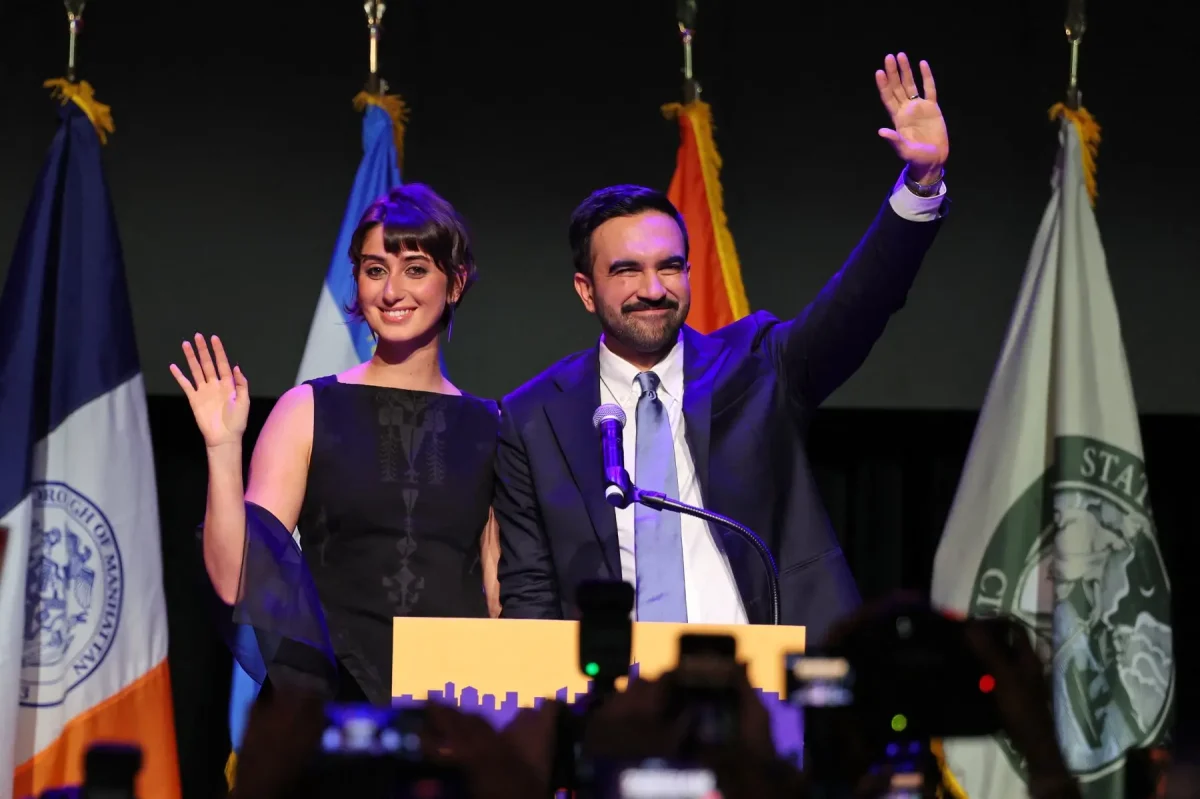
“A history making victory” – this is what ABC News had to say about the New York City Mayoral Election that took place on Tuesday, November 4th, attracting international attention. Just hours after the closing of the polls at 9 PM, Zohran Mamdani, the self-proclaimed democratic socialist, emerged as the winner, beating out Independent candidate Andrew Cuomo and Republican candidate Curtis Sliwa. CBS News states that it was an election with the highest voter turnout since 1969, with over 2 million New Yorkers casting their ballots. Mamdani himself received around 50% of the votes. The Trump-backed former New York Governor Cuomo, according to NBC News, won about 42% of the vote. Curtis Sliwa garnered less than 10% of New York’s votes.
Mamdani will be inaugurated on January 1st, 2026, and will replace the incumbent mayor, Eric Adams, who dropped out of the race in September. Of all the elections across the nation that took place this past Election Day, NYC’s mayoral race was certainly a highlight.
Zohran Mamdani will not only be the youngest mayor that the city has seen in over a century, but he will also be the first Muslim and South Asian mayor. While these two factors have been a cause for excitement for many New Yorkers, thus contributing to his win, Mamdani’s background has faced scrutiny and criticism from his opponents.
As reported by BBC News, Mamdani was born in Uganda in 1991 to parents of Indian descent. When he was seven, the family moved to New York, where Mamdani attended Bronx High School of Science. He also received his college education at Bowdoin College, earning a degree in Africana Studies. Before running for mayor, Mamdani worked as a housing counselor in Queens and as an assemblyman in the 36th Assembly District of New York City. In the final debate before the election, Sliwa criticised Mamdani, stating that his resume “could fit on a cocktail napkin.” Cuomo was also very vocal about Mamdani’s political inexperience and took numerous jabs at the young candidate. However, Mamdani remained seemingly unfazed, correcting the former governor when he mispronounced his name – a moment that went viral: “The name is Mamdani”, he said. “M-A-M-D-A-N-I. You should learn how to say it.”
The major focus of Mamdani’s progressive campaign was his goal to make New York City–the most expensive city in the country–affordable again. Some of his policies that would support this goal are rent freezes, a free bus system, and free childcare. While many have dismissed these ideas as unrealistic, idealistic, or simply impossible, Mamdani has also proposed measures to underwrite their feasibility. He has suggested a 2% increase of taxes on the rich, aimed towards the billionaires of the city.
Though these policies were able to sway the majority of New Yorkers to vote for him, Mamdani has many opponents. Critics argue that his plans are too radical or logistically impractical, while others have concerns over his stance on Israel and the visibility of his Muslim faith in his campaign. As stated by the BBC, the 34-year-old is a strong supporter of Palestine, something that created some controversy, especially because of New York’s large Jewish population. Mamdani’s socialist designation has also faced criticism. His very progressive perspective has made him a target of President Trump, who called him a communist, a title that Mamdani has repeatedly denied.
Despite Mamdani’s public rejection of the Trump administration and the fact that some believe him unfit or too polarizing a candidate for a position like Mayor of New York City, he has repeatedly highlighted that he intends to be a mayor for all New Yorkers. Regardless of religious background or political views, Mamdani has emphasized his plan to ”make this city one that working people can love and live in again.” For many, his declaration of unity was an inspiring message of hope, especially in a time of increasing polarization, where it is a struggle to find common ground. Whether or not Mamdani will fulfill his promises and become the mayor that the city of New York hopes for is something the world will be closely watching.