

March 15, 2026, the 98th Academy Awards Ceremony took place, hosted by comedian Conan O’Brien for the second year in a row.
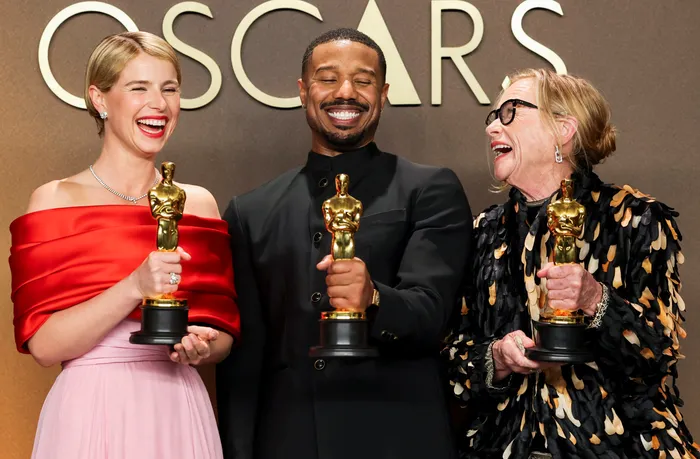
Box office and critical sensation Sinners led the nominations with a record-breaking 16, but garnered only four. The second most wins went to One Battle After Another with six. At the beginning of awards season, Timothee Chalamet was often predicted to win Best Actor in a Leading Role for Marty Supreme, but the odds began to shift when Michael B. Jordan won the SAG award for playing the leading twins in Sinners. Chalamet’s controversial comments claiming ballet and opera were obsolete seemed to be the nail in his coffin. Sinners brought home Best Actor for Michael B. Jordan as well as Best Original Screenplay, Best Original Score, and Best Cinematography (The first ever female winner in the category). Despite valiant marketing efforts and an initial positive reaction, Marty Supreme left the Academy Awards empty-handed.
Most winners of the night (Excluding the major winners of One Battle After Another and Sinners) only brought home one award; however, Guillermo Del Toro’s epic literary adaptation Frankenstein won three, and globally popular K-Pop Demon Hunters won two. Frankenstein obtained Best Makeup and Hairstyling, Best Costume Design, and Best Production Design, while KPop Demon Hunters won for Best Original Song and Best Animated Feature Film.
Amy Madigan’s win of Best Actress in a Supporting Role for playing Aunt Gladys stood out as the only win and only nomination for Weapons. This win has been enjoyed as a very rare moment of appreciation for horror, a genre largely snubbed by the Academy Awards. Having seen Weapons, I agree that Madigan’s performance was a noticeable highlight, but I am also thankful that the awards for the film did not go any further, as it was the only highlight to an otherwise mediocre film.
For the award of Best Actress in a Leading Role, Jessie Buckley took home the only win of the night for acclaimed drama Hamnet, which had eight nominations. This was the final win in Buckley’s achievement of the rare awards season sweep, in which she won the award for leading actress in the Golden Globes, BAFTA, SAG, and Academy Awards. Given this, Buckley’s performance was undeniably moving, but one has to wonder why Hamnet was otherwise unsuccessful at the Oscars. Of course, I am no member of the Academy, but I notice that compared to the big winners of Sinners and One Battle After Another, Hamnet is more personal and less political. A film about grief and love is beautiful and timeless, but it does not have the same cultural relevance as the films that address race, immigration, and other pressing issues.
The notable winner of the night was Paul Thomas Anderson’s One Battle After Another, which took home six awards, including best picture. For this film, Paul Thomas Anderson also won his first award for Best Director after an acclaimed, but Oscar-less career spanning decades. Some observers on the internet have pointed out an intriguing pattern: Star of One Battle After Another, Leonardo DiCaprio, has helped not only Anderson, but two other very well-respected directors win their first and only awards for Best Director: Martin Scorsese and James Cameron.
On thefordian.com, you can find a separate review of One Battle After Another for a more in-depth discussion. As someone coming of age during a time of great political controversy and division, I find the message of One Battle After Another about passing on the political struggle to a new generation deeply touching. In his acceptance speech for Best Adapted Screenplay, Anderson encapsulated this, stating, “I wrote this movie for my kids to say sorry for the housekeeping mess we left in this world we’re handing off to them, but also with the encouragement that they will be the generation that hopefully brings us some common sense and decency.” In my personal opinion, One Battle After Another does not possess the same potency as the genre-bending sensation Sinners, but it is a respectable piece of political art that suffices for the highest honor of Best Picture.